· August 2, 2026
84 Symptoms. Fatigue Was #1. Hot Flashes Were #47.
Where nervous system wisdom rewrites the menopause playbook — part of The Reckoning Years series.
The Symptom the Medical System Treats as Definitive Is What Women Experience as #47
Fatigue. #1. Affects 95% of women.
Hot flashes. #47. Affects 55%.
Night sweats. #43. Affects 62%.
Brain fog. The most logged symptom in the Balance app — 443,097 women globally.
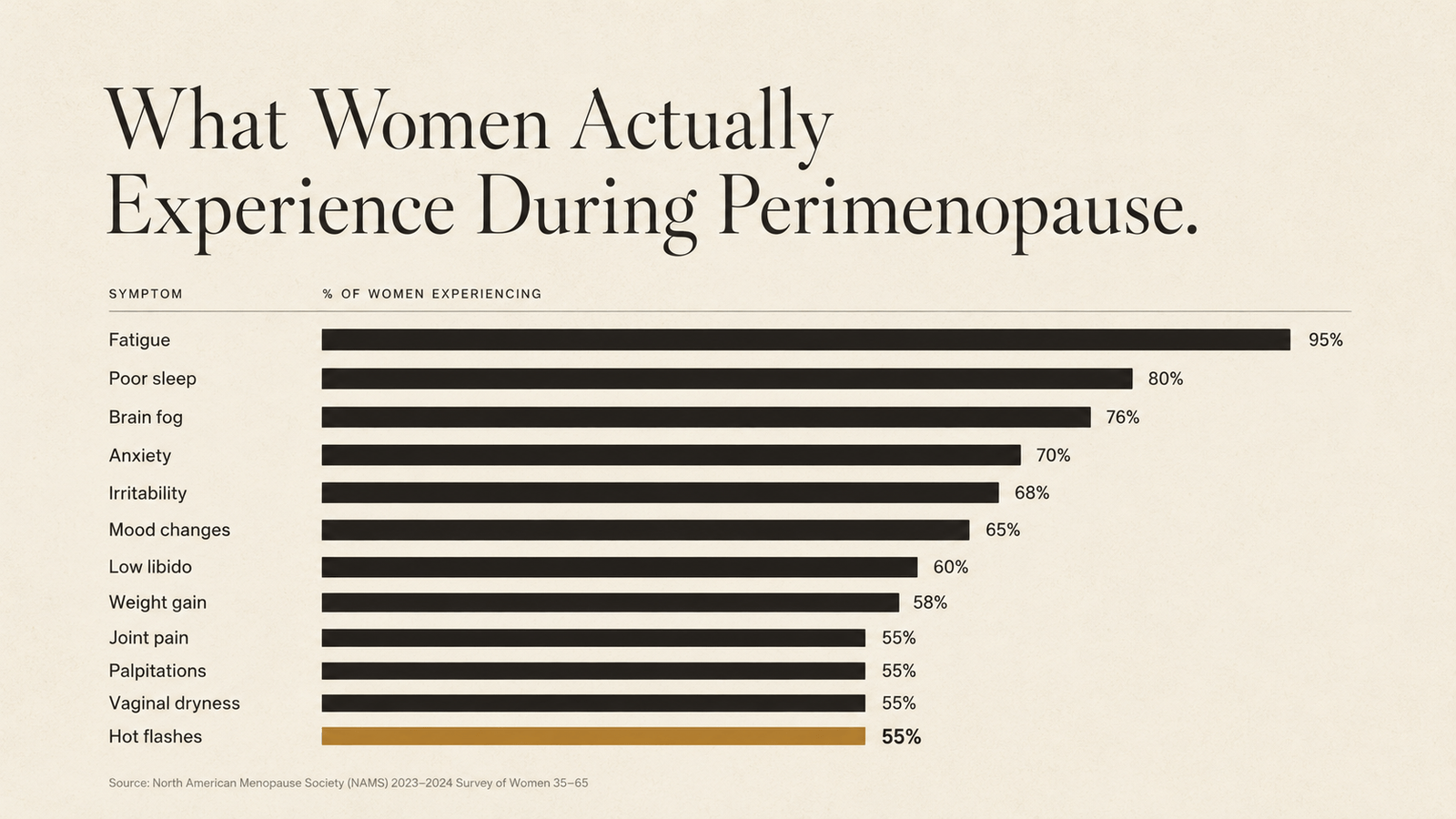
These numbers come from the Newson Clinic 2024 study, the most comprehensive published symptom list for perimenopause/menopause: 84 symptoms tracked across 1,352 patients. Patient-reported, not clinician-observed. What women actually notice, not what gets measured in a clinical trial.
The vasomotor-first narrative — menopause equals hot flashes, give estrogen — is built on the wrong outcome measure.
The symptom list the medical system treats as definitive is not the symptom list women actually experience as most burdensome.
And that mismatch shapes everything: what gets tested, what gets dismissed, who gets help.
The Vasomotor Narrative Doesn’t Match the Data
Here’s what the vasomotor-first narrative looks like in practice:
A woman arrives with nine months of exhaustion, brain fog that makes her miss deadlines, mood shifts that fracture her relationships, sleep disruption that leaves her functioning on 4 hours a night, musculoskeletal pain that makes movement feel like punishment.
Her provider runs labs. Checks her estrogen. Says her hot flashes aren’t bad enough to warrant treatment.
She leaves with nothing.
Her symptoms are real. She is suffering. The framework she was measured against simply prioritizes the symptom she doesn’t have most — over the symptoms that are destroying her life.
The Newson data doesn’t just document this mismatch. It quantifies it:
- Fatigue (#1, 95%) — the symptom most associated with nervous-system overload, HPA axis dysregulation, mitochondrial depletion
- Sleep disruption (top 5) — the symptom most associated with sympathetic bracing, circadian disruption, threat-state persistence
- Brain fog (most logged in Balance) — the symptom most associated with autonomic dysfunction, neuroinflammation, glycemic instability
- Mood symptoms (top 10) — the symptoms most associated with autonomic buffering loss, hormonal volatility, nervous-system load
- Musculoskeletal pain (top 10) — the symptoms most associated with fascial dehydration, connective-tissue changes, structural compensation
The vasomotor symptoms — hot flashes, night sweats — sit at #43-47. They’re real, and they’re distressing. They’re also not the primary burden for most women, and the data says so plainly.
They are the symptoms that respond to HRT. The others require terrain work.
One Overdriven System, Five Different Symptoms
Fatigue, sleep disruption, brain fog, mood disturbance, musculoskeletal pain — five separate lines on the Newson ranking. They read as five separate problems. They’re not. They’re five downstream readouts of the same overdriven system, each one showing the strain in a different tissue.
Start with the sympathetic nervous system staying switched on longer than it should. Sustained cortisol and glucocorticoid signaling impairs the mitochondria’s ability to convert fuel into usable energy — the actual cellular machinery slows down. That’s fatigue: not tiredness, a measurable drop in ATP output.
The same overdrive flattens the cortisol awakening response — the sharp morning cortisol rise that normally cues the sleep-wake transition (Guilliams 2020, HPA Axis in Chronic Disease Management). When that curve goes flat, the signal that tells the body when to downshift into rest weakens, and sleep disruption follows.
Brain fog runs on the same circuit. A system reading sustained threat routes resources toward vigilance — scanning, reacting — and away from the prefrontal processing that supports working memory and follow-through. The fog is where that vigilance tax gets paid — the same resource shift as fatigue and sleep, just landing in cognition instead of muscle.
Mood disturbance tracks a related signal: the phase relationship between cortisol and estradiol shapes affect regulation, and when menopause’s hormonal decline pulls that relationship out of its normal rhythm, mood volatility is the readout.
Musculoskeletal pain is where the overdrive turns physical. Sustained sympathetic and catecholamine signaling changes how fascial tissue behaves — myofibroblast activity shifts, tissue tightens, movement that should be effortless starts to hurt.
Five symptoms. One mechanism, branching five ways depending on which tissue absorbs the load.
The vasomotor symptoms — hot flashes, night sweats — run on a narrower, different circuit: estrogen normally widens the thermoneutral zone, and its withdrawal collapses that zone, so small stimuli trigger a heat-loss response. Real, but a genuinely different mechanism than the five above.
HRT addresses that narrower circuit directly. It can soften some of the sympathetic load driving the other five, but it cannot rebuild the mitochondrial output, the cortisol curve, or the fascial tension state those five symptoms actually depend on.
Which is why so many women who take HRT still feel terrible.
What This Means for Treatment
The mismatch between the vasomotor-first narrative and the actual symptom burden has three concrete consequences:
1. What gets tested is wrong.
If you’re testing for menopause based on hot flash frequency, you’re testing for the symptom that ranks #47. You’re not testing for the symptoms that rank #1-5. The intake should map the full symptom landscape — fatigue, sleep, cognition, mood, pain — before deciding what to treat.
2. What gets dismissed is real.
“Your hot flashes aren’t bad enough to treat” is a statement about a specific intervention threshold, not about symptom severity. But it lands as dismissal. The woman leaving that appointment doesn’t hear “your vasomotor symptoms don’t meet the HRT threshold.” She hears “your suffering isn’t valid.”
3. Who gets help is narrow.
Women with nervous-system-dominant presentations — the ones with fatigue, brain fog, mood disturbance, sleep disruption — go unrecognized. They’re told their labs are normal, their hot flashes aren’t bad enough, they should just manage stress.
They’re not managing stress. They’re managing a system that is processing threat chemistry without clearance.
What Rebuilding Feels Like
Rebuilding moves in an uneven line. The symptom burden thins out gradually — it doesn’t drop off a cliff the day you start doing the right things.
What it actually looks like:
- Week one: You start tracking your symptoms. Fatigue turns out to have a texture — heavy, resistant, like wading through water.
- Week two: Sleep disruption gets specific too: waking at 3 AM with your heart racing, unable to fall back asleep until 4:30.
- Week three: You start seeing the pattern. The fatigue, the sleep disruption, the brain fog — they cluster. They come together. They’re not separate problems.
- Week four: You start addressing the terrain — sleep protection, meal timing, nervous-system downshifting. The symptoms don’t vanish. But they start to cluster differently. Some flares pass faster. Some mornings are easier.
- Week eight: You notice you didn’t reach for coffee to survive the afternoon. You notice your brain fog lifted enough to finish a conversation without losing your thread.
The markers of improvement aren’t dramatic. They’re subtle:
- Flares come and go instead of settling in permanently
- Recovery takes hours instead of days
- The gap between “fine” and “fragile” widens
- You start recognizing the difference between exhaustion and fatigue
- Rest actually rests
What looks like chaos from the inside is the system rehearsing precision — learning to handle stability without collapsing.
Micropractice: The Symptom Texture Read
When you’re tracking your symptoms, don’t just log frequency and severity. Log texture.
- Pause. When a symptom hits — fatigue, brain fog, pain, mood shift — stop what you’re doing. Place one hand on your belly, one on your breastbone.
- Register the quality. Is the fatigue heavy or sharp? Is the brain fog dense or scattered? Is the pain localized or diffuse? Don’t judge it — just note the qualities.
- Check the cluster. Has this sensation come with others? Fatigue + brain fog + sleep disruption? Pain + stiffness + mood shift? Symptoms that cluster are likely sharing a driver.
Over time, the clusters become diagnostic. They tell you what’s actually happening — not just what’s happening, but what’s driving what.
A fatigue that clusters with sleep disruption and brain fog is likely nervous-system-mediated. A pain that clusters with stiffness and mood shift is likely structural-compensation-mediated. A hot flash that comes alone, without the cluster, is likely vasomotor-mediated.
Different drivers. Different interventions.
What Working With Me Looks Like For This
In my practice, when a woman arrives with a list of symptoms that doesn’t match her labs, we don’t treat the list. We treat the pattern.
The intake maps which symptoms cluster, which textures they have, which drivers they share. The SWIM lens sorts which variable is driving the burden hardest — inflammation, hormones, metabolism, microbiome. The Vital Clarity Code — the framework I use to sequence what gets addressed first — does that work here.
Hands-on work targets the bracing patterns that keep the system stuck in sympathetic overdrive — jaw, diaphragm, chest, pelvis. Because you can take all the HRT you want, but if the body is still bracing against a threat that’s already passed, the terrain isn’t changing.
My practice is in Rathdrum, Idaho — in-person for the Coeur d’Alene corridor, virtual for everyone further out.
A Vital Signal Check maps your symptom clusters and names the first driver to address, in 45 minutes. If stored bracing is keeping the sympathetic overdrive alive, a Midlife Body Reset works the bracing directly.
84 Symptoms of Perimenopause and Menopause: Common Questions
What are the most common symptoms of perimenopause and menopause?
According to the Newson Clinic 2024 study — 84 symptoms tracked across 1,352 patients — fatigue ranks #1 (affecting 95% of women), followed by sleep disruption, brain fog, mood symptoms, and musculoskeletal pain. Hot flashes rank #47 (affecting 55%). The symptom list the medical system treats as definitive is not the symptom list women actually experience as most burdensome.
Why are hot flashes not the #1 symptom if they’re what menopause is known for?
Because the medical system measures menopause by vasomotor symptoms — hot flashes, night sweats — which respond to HRT. The symptoms that rank highest — fatigue, sleep disruption, brain fog — are nervous-system-mediated and require terrain work. The framework shapes what gets measured, what gets treated, and what gets dismissed.
Can HRT help with fatigue, brain fog, and mood symptoms?
HRT can soften the jagged parts of nervous-system-mediated symptoms, but it cannot rebuild the terrain those symptoms depend on. If your primary burden is fatigue, brain fog, sleep disruption, or mood disturbance, HRT may help some of the vasomotor components, but the underlying terrain — autonomic buffering, mitochondrial capacity, nervous-system load — requires different intervention.
TL;DR
- Fatigue was #1. Hot flashes were #47. The Newson Clinic 2024 study (84 symptoms, 1,352 patients) reveals the symptom list women actually experience as most burdensome is not the symptom list the medical system treats as definitive.
- The vasomotor-first narrative is built on the wrong outcome measure. It prioritizes the symptom that responds to HRT over the symptoms that destroy daily function.
- Most of the burden is nervous-system-mediated, not vasomotor. Fatigue, sleep disruption, brain fog, mood disturbance, musculoskeletal pain — all symptoms of a system running on sympathetic overdrive without clearance.
- Different drivers require different interventions. HRT addresses vasomotor symptoms directly. Nervous-system-mediated symptoms require terrain work.
- The mismatch shapes what gets tested, what gets dismissed, who gets help. Women with nervous-system-dominant presentations go unrecognized because they’re measured against the wrong framework.
Every symptom cluster traces back to a driver — autonomic overdrive, mitochondrial depletion, structural bracing, hormonal volatility. Which driver is loudest in your own list only shows up in your own terrain, and that’s what a Vital Signal Check names first.
Keep Reading
More on menopause symptoms and nervous-system-mediated burden:
- Why Menopause Symptoms Don’t Disappear With Normal Labs — the same framework mismatch from the lab-results side: why “normal” doesn’t mean “fine.”
- Menopause and Fascia: The Hidden Symptom — explains why musculoskeletal symptoms dominate the 84-symptom list.
This post lives within the Menopause Hub, where symptoms stop being problems and start being signals of capacity, hormones, metabolism, and nervous-system load.