
🌕 Where nervous system wisdom rewrites the menopause playbook—part of The Reckoning Years series.
The First One
You remember where you were.
Maybe it was 26, midway through grad school. Maybe it was 34, deep in the early-kids-plus-career chaos. Maybe it was last year, when you finally stopped long enough to look.
You plucked it. Or you didn’t. Either way, you filed it under “genetics” or “just aging” and moved on.
Here’s the thing: that follicle wasn’t betraying you. It was taking notes.
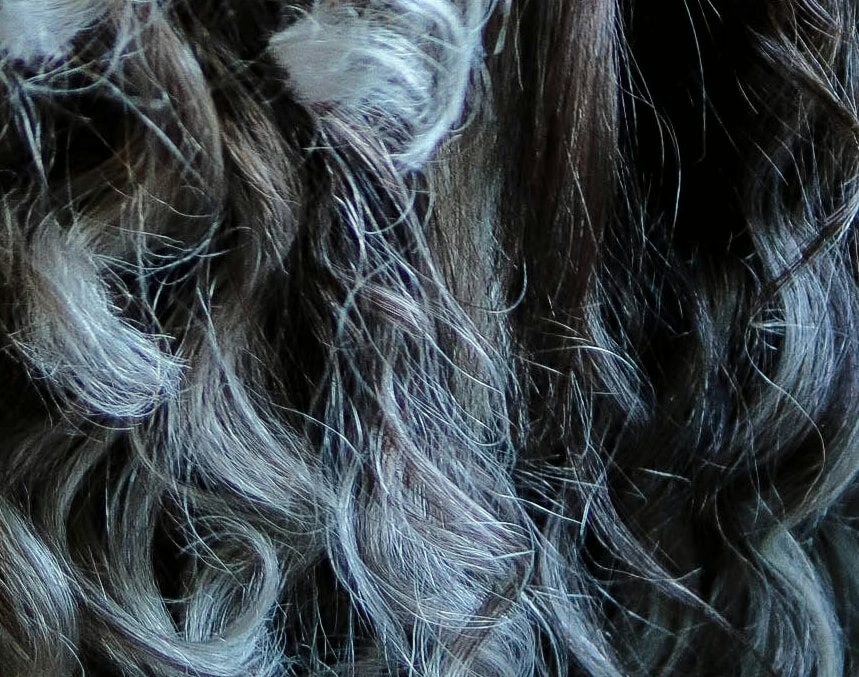
Gray hair isn’t a cosmetic event. It’s not a switch that flips at some predetermined age. And it’s definitely not something you failed to prevent with the right supplements.
It’s a receipt. A timeline of how long your system has been braced, depleted, and running on margin you didn’t actually have.
The Reframe
The mainstream story is simple: melanocytes die, pigment stops, hair goes gray. Genetics loads the gun, aging pulls the trigger. Cute, tidy, wrong.
What’s actually happening is more interesting and more useful.
Gray hair is a load signature—a visible record of oxidative stress, sympathetic overdrive, circadian fragmentation, nutrient depletion, and mitochondrial fatigue layered over decades. The melanocyte stem cells that produce pigment are exquisitely sensitive to their local environment. When that environment shifts from regenerative to defensive, the stem cell niche collapses. Once it’s gone, it’s gone.
This is why midlife hits different. Perimenopause and menopause don’t cause graying—they stop letting you get away with the cumulative metabolic and neuroimmune tab you’ve been avoiding. The system shows what it’s been carrying long before hair color changes.
That first gray at 26? Your nervous system was already documenting the override. You just couldn’t read the receipt yet.
The Terrain Underneath
Oxidative Stress and the Stem Cell Niche
Melanocyte stem cells live in the hair follicle bulge, and they’re spectacularly vulnerable to oxidative damage. Hydrogen peroxide accumulates naturally in follicles, but healthy systems have robust antioxidant defenses—particularly catalase—to neutralize it. Under chronic stress, inflammation, or nutrient depletion, those defenses falter. The peroxide builds. The stem cells die or fail to differentiate.
This isn’t aging. This is terrain.
Sympathetic Overdrive
Your autonomic nervous system has opinions about hair pigment. Research published in Nature (2020) demonstrated that acute stress depletes melanocyte stem cells through norepinephrine signaling—the fight-or-flight neurotransmitter literally kills the cells that make pigment. This isn’t metaphor. Sympathetic overdrive is writing itself into your keratin in real time.
The women who go gray earliest often aren’t the ones with the “worst genes.” They’re the ones who ran the hottest, longest, with the least recovery. Graduate programs, caregiving years, high-capacity careers with no off-switch—these aren’t risk factors for gray hair because of calendar time. They’re risk factors because of nervous system time.
Mitochondrial Load
Melanocytes are energy-intensive. Pigment production requires functional mitochondria with adequate substrate and minimal oxidative leak. When mitochondrial efficiency drops—from glycemic volatility, sleep fragmentation, chronic inflammation, or plain old metabolic overload—pigment production is one of the first things to get triaged.
Your hair is revealing what your pancreas, your liver, and your sleep architecture have been negotiating quietly in the background.
The Immune-Nervous System Axis
Chronic immune activation and low-grade inflammation create a follicular microenvironment hostile to melanocyte survival. The same terrain patterns that drive autoimmune flares, histamine intolerance, and inflammatory symptoms are creating conditions where pigment-producing cells can’t thrive.
Gray hair and perimenopause severity often share a root cause: a system that’s been in defensive mode so long it forgot how to regenerate.
About Those Supplements
Let’s address the elephant in the room: the supplement stacks promising to reverse gray hair.
Catalase supplements. Copper. B12. PABA. Fo-Ti. The “gray hair reversal” protocol du jour.
Here’s what’s true: some nutrient deficiencies (B12, copper, iron) can contribute to premature graying, and correcting a genuine deficiency may slow progression. Catalase is legitimately involved in protecting melanocytes from oxidative damage.
Here’s what’s also true: once the melanocyte stem cell niche has collapsed, no supplement stack resurrects it. You cannot catalase your way back to 25. The studies showing “reversal” are either measuring something else (like improved hair quality being perceived as less gray), working with deficiency states, or operating on timelines and sample sizes that don’t survive scrutiny.
The supplement-stack fantasy is the same addiction to control dressed up in different packaging. It’s still looking for a hack when the system needs a habitat change.
This doesn’t mean nutrition doesn’t matter. It means nutrition matters upstream—as part of terrain restoration, not as a paint job for damage already done.
🌟 Through the Vital Clarity Code Lens
🌱 Regulate
You cannot reverse graying, but you can stop accelerating it.
This phase is about shifting the system out of threat physiology and restoring the regenerative windows that protect remaining melanocyte stem cells. It’s not sexy. It’s not a protocol. It’s the boring, foundational work of convincing your nervous system that the tiger has left the building.
Circadian anchoring. Blood sugar stability. Sleep architecture that actually includes slow-wave phases. Breathing patterns that don’t signal emergency. These create the baseline conditions where oxidative defenses can function and stem cell niches can stabilize.
🌀 Rewire
Mitochondria respond to rhythmicity, not hacks.
This phase rebuilds the metabolic and autonomic pathways that support pigment stability—not through supplements, but through signal. Improved CO₂ tolerance. Restored circadian hormone patterns. Enhanced microvascular flow to the scalp and follicles.
Cold exposure, done correctly, isn’t about “boosting metabolism.” It’s about training microvascular responsiveness and metabolic flexibility. Movement that builds rather than depletes. Nutrient density that supports methylation and glutathione recycling without creating more metabolic work.
🔥 Reclaim
Once margin returns, the body can actually use what you give it.
This is where nutrient repletion strategies have a chance of working—not as gray-hair-reversal protocols, but as support for a system that’s no longer in triage mode. B12 and copper and iron can do their jobs when the terrain isn’t actively hostile.
More importantly, this is where you stop treating gray hair as failure. The shame narrative—that visible aging is something to fix, hide, or reverse—is its own form of stress. Reclaiming means refusing the frame that your body documenting its history is a problem to solve.
✨ Resonate
The goal was never to look 25 forever.
The goal is a system that stops writing stress into keratin because it’s no longer running on override. Biology becomes rhythmic again. The body stops documenting emergency because emergency has actually ended.
Some hair may repigment at the roots. Most won’t. What changes is the trajectory—and your relationship to what your body has recorded.
🪶 Micropractice: The Margin Moment
This is a two-minute reset designed to shift your system out of sympathetic overdrive and improve microvascular flow to the scalp. Not because it will reverse your gray hair. Because it interrupts the pattern that accelerates it.
- Exhale longer than you inhale — five breath cycles. Count 4 in, 6-8 out. This shifts autonomic tone faster than almost anything else.
- Gentle cervical glide — slowly turn your head left, return to center, turn right. No forcing. Let the neck remind the brainstem that you’re not bracing.
- Brief cold stimulus — 20 seconds of a cold, wet cloth on your forehead or cheeks. This triggers the dive reflex, shifts blood flow patterns, and signals “not emergency” to your autonomic nervous system.
- Slow re-entry breath — one long, easy breath before you return to whatever you were doing.
Do this daily. Not because it’s a gray-hair cure. Because it’s a nervous-system intervention that changes what your follicles are swimming in.
TL;DR
Gray hair isn’t aging. It’s a load signature.
It’s the cumulative record of oxidative stress, sympathetic overdrive, and metabolic margin you didn’t have—written in keratin over decades.
Midlife doesn’t cause graying. Midlife reveals the terrain that’s been operating past its margin for years.
You can’t supplement-stack your way to reversal. Once the melanocyte stem cell niche collapses, it’s gone.
But you can change the trajectory. Not by reversing the gray—by stopping the acceleration. By shifting the terrain from emergency to regeneration.
Your hair has been taking notes. The question isn’t how to erase them. It’s what you want it to record next.
Ready to decode what your body’s been documenting?
Start with a Vital Signal Check →
This post lives within the Menopause Hub, where we decode hot flashes, sleep changes,
weight shifts, libido, and brain fog —even gray hair — through the lens of capacity, metabolism & the nervous system.