
🌗 Where nervous system wisdom rewrites the perimenopause playbook—part of The Reckoning Years series.
Dana, 44, used to jog before sunrise.
Color-coded calendars. Inbox zero by 9am. Lunch was whatever she could eat one-handed between responsibilities. She was the one people called when things needed to get done — and she always delivered.
Then — slowly, then suddenly — she couldn’t push anymore.
Workouts that used to energize her now left her wrecked for two days. Coffee in the morning felt like CPR for a nervous system that had stopped responding to pep talks. Sleep was either wired-at-midnight or crashing-at-8pm like a felled tree. The gym became a place she drove past with guilt instead of entering with purpose.
She sat across from me, arms crossed, more ashamed than sick.
“I’m just so tired. I used to be unstoppable.”
At the end of our session, after we’d mapped the timeline of her unraveling, she added quietly:
“I think I broke something. And I don’t know if I can fix it.”
She hadn’t broken anything. Her body was doing exactly what it was supposed to do when the account runs dry.
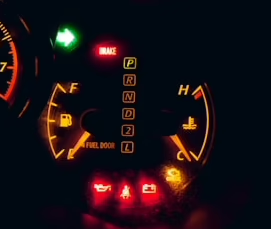
The Reframe
This wasn’t burnout in the “I need a vacation” sense. This was neuroendocrine collapse.
Chronic output with no recovery creates predictable physiology: the HPA axis dysregulates. Cortisol feedback loops fail. The rhythm flattens: no morning spike, no evening drop, just a flat gray line of exhaustion. Mitochondria downshift to conservation mode. The immune system starts running a low-grade inflammatory hum that never quite resolves.
Add perimenopause to the mix—progesterone fragile under stress, estrogen oscillating unpredictably—and you get a system that can’t buffer anything anymore.
Dana wasn’t failing at willpower. She was running a survival operating system on a machine built for cycles, not sprints.
Fatigue wasn’t betrayal. It was intelligence.
🌟 How Dana’s System Reorganized (Through the Vital Clarity Code Lens)
🌱 Regulate
The first shift wasn’t adding anything — it was stopping the bleeding.
Dana had been “fasting by accident” most mornings: coffee until noon, then cramming calories into the afternoon. Her body read this as famine. We started with breakfast that actually existed: protein, minerals, food that told her metabolism the crisis was over.
Three meals. Post-meal walks instead of HIIT punishment. Magnesium and omega-3s to calm the inflammatory hum. A hard digital sunset — screens down, lights dim, nervous system signaled that the day was actually ending.
She didn’t believe it would matter. It did.
Within three weeks, the 3pm crashes softened. She stopped waking at 4am with her heart racing.
🌀 Rewire
Once the bleeding stopped, we could rebuild capacity.
Resistance training came back, but submaximal, not grinding. The goal wasn’t to burn calories; it was to tell her muscles they still mattered. We added adaptogens carefully. Ashwagandha only because she wasn’t the wired-tired type, and only after her baseline stabilized.
Sleep developed structure again. Not perfect, but phases — the kind where you wake up and know you actually slept.
She started recovering from workouts instead of being destroyed by them. That was the signal her mitochondria were coming back online.
🔥 Reclaim
Dana stopped treating rest as moral failure.
For years, she’d worn exhaustion as a badge: proof she was doing enough, giving enough, being enough. Burnout had stripped that story away. She couldn’t perform productivity anymore, so she had to find another measure of worth.
She started protecting her energy like it was finite. Because it is. Saying no without apology. Letting things be good enough instead of perfect.
Her irritability faded. Not because hormones magically balanced, but because she wasn’t running on emergency reserves anymore.
✨ Resonate
Four months in, something quieter shifted.
Dana started having ideas again. Creative impulses. The desire to do things that weren’t on a task list.
That’s how we know vitality is actually back: not just the absence of exhaustion, but the presence of generative energy. The kind that wants to make something, not just survive something.
She told me: “I don’t negotiate sleep for productivity anymore. Because I finally feel good enough not to.”
🪶 Micropractice: The Two-Minute Exit Ramp
Wherever you are, pause.
Exhale longer than you inhale. Twice.
Drop your shoulders away from your ears.
Unclench your jaw.
Let your tongue fall from the roof of your mouth.
This isn’t meditation. It’s a pattern interrupt.
You’re showing your nervous system it can stand down — even briefly.
TL;DR
Dana’s burnout wasn’t lack of drive.
It was proof she drove without refueling for too long.
Ready to decode your own patterns?
Curious what your fatigue might actually be saying?
Start with a Vital Signal Check →
More on Nervous System Health
This case story is part of the Fatigue Hub, where we explore what fatigue actually signals and how to restore capacity without forcing recovery.
For more on how perimenopause amplifies burnout patterns, see the Perimenopause Hub.