
Where place meets physiology — part of the Inland Northwest Series.
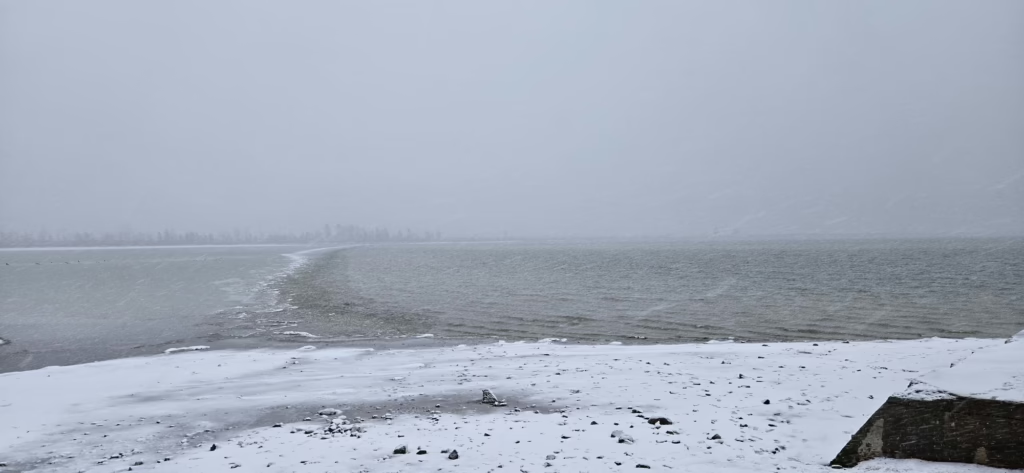
This isn’t cozy hygge winter. This isn’t “embrace the darkness” wellness winter. This is Inland Northwest winter — where the cold is real, the light disappears for months, and your nervous system has opinions about both.
What Winter Actually Does To Midlife Physiology
The physiological load nobody names: prolonged darkness that drifts your melatonin and cortisol timing, cold exposure without adequate warmth recovery, reduced spontaneous movement (not laziness — physics), social contraction that compounds isolation, and vitamin D and dopamine depletion running in parallel.
This isn’t seasonal affective disorder as a tidy diagnosis. This is cumulative compression — systems being asked to run on less while outputting the same.
Your body isn’t failing winter. Winter is asking more than your body has to give.
Why Midlife Amplifies This
Estrogen withdrawal destabilizes circadian rhythm integrity, thermoregulation (already challenged by cold), insulin sensitivity (carb cravings aren’t moral failure), immune modulation (winter viruses hit different now), and sleep architecture (which is light-dependent, and there’s no light).
The nervous system that used to coast through December now registers threat earlier, recovers slower, and signals louder. What worked at 33 — pushing through, banking on spring — doesn’t clear the same way at 48.
In midlife, you’re running winter on a body with less hormonal insulation. The margin that used to absorb seasonal stress has thinned. December asks the same questions it always did; your body just has fewer good answers.
The Patterns I See Clinically
Sleep that “looks fine” on a tracker but leaves you wrecked. Energy that craters mid-afternoon and never recovers. Mood flattening that isn’t depression but isn’t okay either. Cravings that spike precisely when willpower tanks. The January wall — when holiday momentum stops and the body finally admits it’s tired.
The common thread: systems that have been overriding signals since October finally run out of workarounds. The women who show up in my office in January and February aren’t weak. They’re honest. Their bodies stopped pretending before they did.
What Actually Helps (This Is Not a Protocol)
This isn’t a “10 tips for winter wellness” list. It’s a reframe.
Light before discipline. Morning light exposure — even gray light — matters more than your workout right now. Your circadian system is starving. Feed it first.
Warmth as input, not reward. Your nervous system reads cold as threat. Offset it intentionally: hot drinks, warm layers, baths that aren’t earned. Warmth isn’t indulgence. It’s regulation.
Movement that doesn’t cost more than it gives. Gentle trumps grinding in compression season. A walk that leaves you settled is worth more than a workout that leaves you wired.
Social contact that doesn’t require performance. Compression deepens in isolation, but forced socializing isn’t the answer either. Find the people who don’t need you to be “on.”
Permission to run at 70%. This is not laziness. This is seasonally appropriate pacing. The goal isn’t to optimize winter. The goal is to exit it with your capacity intact.
What Looks Like Medicine But Might Not Be
Some winter strategies sound good on paper but cost more than they give — especially for a midlife nervous system already running compressed.
The snowbird escape. Some women swear by it — a week in Arizona, a long weekend somewhere with actual sun. I get the appeal: light, warmth, a nervous system that finally unclenches. But travel itself is a stressor. The disruption of leaving, the sleep in a different bed, the re-entry when you come back to 19 degrees and a dark house. For some women, especially those already running on thin margin, the rhythm disruption costs more than the sunshine gives. That doesn’t mean don’t go. It means know what you’re trading. If your system is robust enough to absorb the transition costs and you come back genuinely restored — not just distracted — it might be worth it. But if you return more depleted than when you left, the escape wasn’t medicine. It was a loan.
The cold plunge. Yes, we have a lovely mobile sauna and cold plunge operation in town. Yes, contrast therapy has real physiological benefits — vagal tone, inflammation modulation, the whole circuit. But deliberate cold exposure is a stressor. A beneficial one, potentially — but only if your system has the capacity to absorb it and rebound. In a season that’s already compressing you, adding more cold and calling it “hormesis” might be asking a body that’s already bracing to brace harder. If you love it and you leave feeling regulated, not wired — carry on. But if you’re doing it because you think you should, because it’s what resilient people do, and you’re white-knuckling through the plunge waiting for the benefits to kick in? That’s not building capacity. That’s performing it. Warmth is also medicine. Sometimes the braver choice is the hot tub.
The Real Measure
Winter in the Inland Northwest isn’t something to power through. It’s something to survive with your nervous system still speaking to you — so when spring comes, you’re actually ready to meet it.
The women who do winter well aren’t the ones who white-knuckle their way to March. They’re the ones who let the season be what it is: compression. Contraction. A time to run slower, need more, and stop pretending that’s a problem.
Spring will ask for expansion. You can’t give what you didn’t protect.
If this landed and you want to talk about what your body’s actually asking for this winter — that’s what the Vital Signal Check is for.
This is part of the Inland Northwest Series — essays on how place shapes midlife physiology. Start with Not Coastal, Not Cushioned for the full terrain picture.